
- Music
- 15 Nov 26
Ocean Colour Scene's Steve Cradock: "The songs are still there – they still live and breathe"


Steve Cradock of indie kingpins Ocean Colour Scene talks about the band’s hotly anticipated Dublin shows, the heyday of Britpop, and supporting Oasis at Knebworth.
Britpop era legends who achieved huge success with ’90s albums like Moseley Shoals and Marchin’ Already, Ocean Colour Scene shortly hit 3Olympia for a trio of keenly awaited shows. Also known as long-time wing-man for Paul Weller, earlier this year OCS guitarist Steve Cradock was also in Dublin with his tour Traveller’s Tunes, which shared its title with his recent memoir.
Drawing on the band’s deep cuts as well as his own solo material, the tour offered Cradock the chance to take stock of his past.
“It’s looking back while working forward, isn’t it?” he considers. “What I did on the tour was two sets, and it was acoustic based. I went out with my family – I had my boy Cass playing second guitar and keyboards, and I had my wife singing. I’m not trying to put myself in that position at all, but it reminded me of the recent Wings documentary, Man On The Run. It was sort of that family vibe.
“We did quite a few tunes off the Ocean Colour Scene compilation, B-Sides, Seasides And Free Rides, and album tracks from the band we never played as a group before. We also did a folk acoustic version of ‘The Riverboat Song’, so they were different takes on the tunes. I also did stuff from my solo albums, and songs off a record I did with PP Arnold, which I produced back in 2019.”
Was a stripped down down acoustic set something you’d wanted to do for a while?
“The tour and the book, as a package, was offered to me,” Cradock explains. “I realised I wasn’t particularly doing much in the first half of the year, so I thought about it for a while, and I thought it would be exciting to go down that road. In terms of the book, doing something like that had never really been on my radar.
“But I’ve not sat down and written about my life, it’s not one of those sorts of books. The way I got around it was, I said, ‘Just give me 60 questions and I’ll expand on it.’ That process became the book. It’s a great picture book also, and it’s just really well done, really well made, and it looks classic – even if I say so myself.”
On the Ocean Colour Scene front, are the band working on any new material?
“Well, Ocean Colour Scene haven’t done a record for 14 years,” says Cradock. “But I think that’s gonna change, and next year we’ll have something together. We’ve got about four tunes in the pot so far. We’re doing this tour, and I like the idea that maybe we can get a seven-inch single to sell, or maybe it can be released before the tour. I think that would be good, and we’re nearly close for that to be a reality.”
In their mid-’90s heyday, Ocean Colour Scene were one of Britain’s biggest bands, with Moseley Shoals going multi-platinum on the back of hits like ‘The Riverboat Song’ and ‘The Day We Caught The Train’. Did the success of the album take the group by surprise?
“It did, absolutely,” nods Cradock. “But I guess with hindsight, it had been brewing. Before the Stone Roses released their debut, it was called indie music. It suddenly became the nation’s popular music, along with rave and acid house. Those two underground forms of music became the popular choice.”
Alluding to a suburb in the band’s native Birmingham, Moseley Shoals is a play on Muscle Shoals, the Alabama studio where many classic ’60s soul records were made. Was it through Ocean Colour Scene’s love of mod culture that they were introduced to artists like Otis Redding and Aretha Franklin?
POWERFUL MUSIC
“It’s definitely all linked in,” agrees Cradock. “Mods love that music, although I don’t know if you could call it mod music. It’s soul and church music, isn’t it? Black American soul music. But it just really spoke to us, in the same way it spoke to northern soul fans in the middle and north of England. They became fans of that unheard soul music, and it became a thing.
“I don’t know where you can start really, but if you go back to Otis Redding, Aretha Franklin and Sam Cooke, it’s powerful music. It’s spiritual, isn’t it? The mods took that on, and all the Tamla stuff, through to the Stax stuff of the ’60s. It’s what they used to listen to. It doesn’t make us mods, really, or revivalists – it’s just great music.”
OCS also had a notable love of ’60s psychedelia, which manifested on the memorable cover of Moseley Shoals.
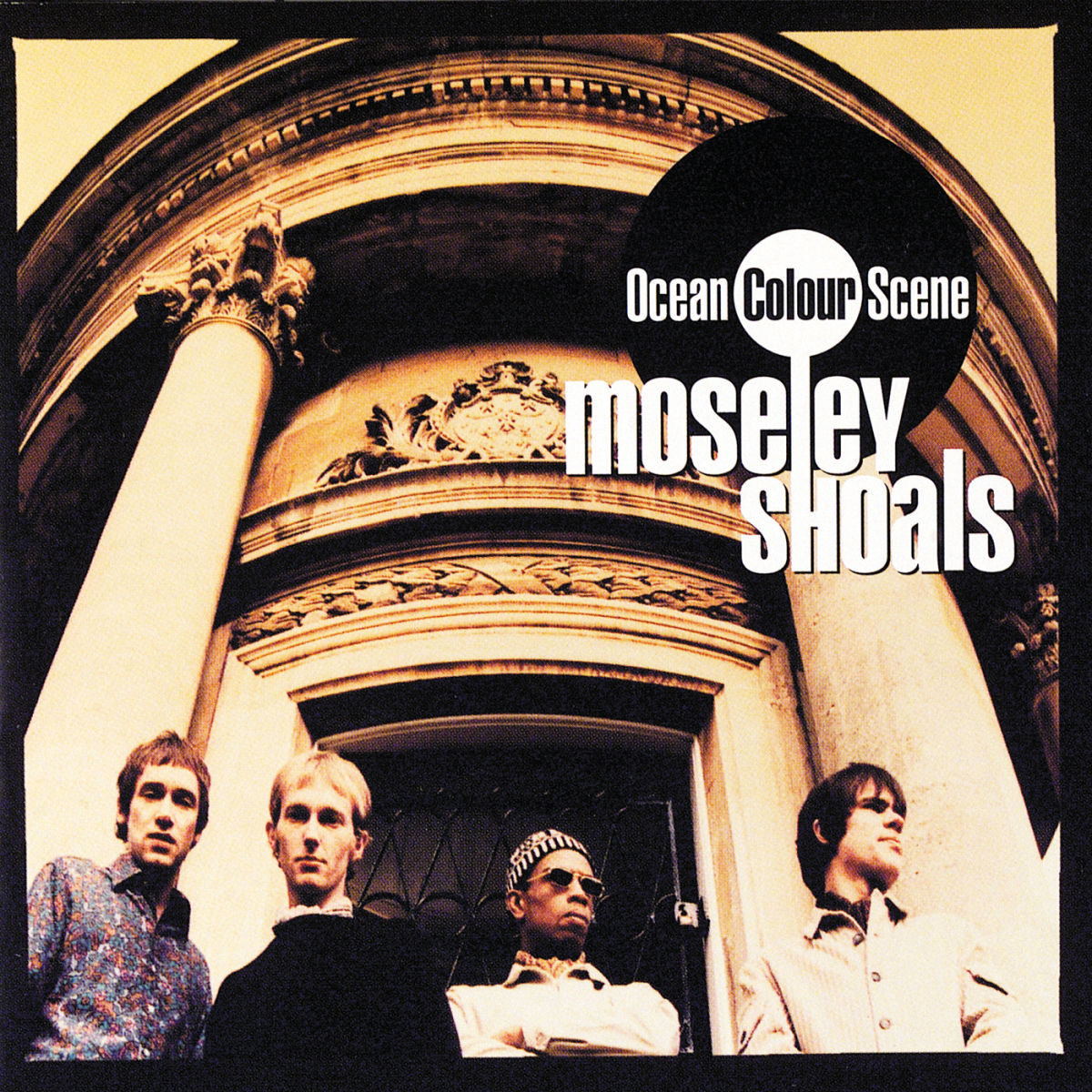
“It was taken in Leamington Spa,” Steve recalls. “That’s all down to a photographer called Tony Briggs. In the book I’m putting out, there are a lot of Tony’s photos of that era. He had that idea for that cover, and he’s responsible for making it iconic. In them days, every time you released a single, you released two CDs, which included eight tracks overall. So every time you were releasing a single, it was not far off an album.
“We were always busy doing b-sides, and we worked at John Rivers’ studios in Leamington Spa. He’s the guy who produced ‘Ghost Town’ by The Specials. Weirdly enough, we had the trombone player on ‘Ghost Town’, Rico Rodriguez, playing on a couple of our tracks. Anyway, Tony was up there taking photos, and he found that building in Jephson Gardens.
“He said, ‘Let’s go over there and take a few pictures, I think it’s going to be good.’ It was about an hour out of that day’s recording schedule. We went over, it was bish-bosh with the camera, and then we went back into the studio for the rest of the weekend. So a lot of thanks and blame to Tony for coming up with the front cover.”
That heady period for Ocean Colour also saw them support Oasis at their legendary 1996 gigs in Knebworth, where Liam and Noel again return on tour next year. Previously, OCS had also supported Oasis at the end of 1995 – was that the springboard to reaching a bigger audience?
“Well, it was incredible fun,” says Steve. “We played the Riverside in Newcastle, the Astoria in London and Leeds Warehouse, so it wasn’t opening up to huge audiences. I mean, those gigs are sort of 1000 at the most, I would imagine. But they were fast becoming iconic – I mean, Oasis were kind of iconic from the start, weren’t they?
“So it was just a joy. We met people who were into the same sort of music, and we were fortunate enough to hang with them. We’d chat music, shoes, clothes, and we had a great time with them.”
How was the experience of playing Knebworth?
“It was incredible,” Steve enthuses. “I mean, 125,000 people. It was culturally important – before that, I guess we only had Spike Island, post the illegal raves. So it was incredible, and it was an honour to be asked to play there. There was the Manics on our day as well – there were all these great groups playing. The Bootleg Beatles! And then Oasis came on and just smashed it, like the giants they are.
“I did go see Oasis last year, I went to see one of the Wembley gigs. They were off-the-scale incredible. What was beautiful is music’s all about the communion, it’s about the interaction with people. In every part of Wembley, the audience were just out of their seats rocking. It was really powerful and I thought Liam sang beautifully, really fucking great singing. And then there was Noel’s guitar playing.
“And to have Bonehead back in the group, I thought was special. He’s kind of an unsung hero of Oasis, and it makes a difference having his guitar in the mix, definitely.”
It was truly remarkable that the tour became a cultural event in every city it visited.
“It was a serious thing, yeah,” acknowledges Cradock. “It was a meeting of people, and it was just the love of Oasis, I guess. So many people around the world soaked that up, didn’t they? I’m really pleased they got it back together.
SPECIAL TIME
“I last saw Noel when I worked with Paul Weller on Find El Dorado, his covers album that came out last year. Noel came down to play on the track ‘El Dorado’. That was before the gigs, and he was excited.”
In researching our interview, I also came across an awesome cover Ocean Colour Scene once did of ‘Daytripper’, on which Liam and Noel also guested.
“Yeah, that was maybe 1995 or ’96,” says Cradock. “I can’t even remember the venue, but it was a small gig in Camden, with around 800 people. We had The Real People supporting us, who had history with Oasis. And then Liam and Noel came down, and they did an acoustic support. This was before Morning Glory came out, and they played about six songs off it acoustically, which sounded incredible. And then they came and joined us for a version of ‘Daytripper’.”
In the current revival of cultural interest in the ’90s, it’s impossible to get away from the fact it was a much more harmonious time than the 2020s – it feels like people want to remember a happier period for the world.
“Yeah, I get that,” says Cradock. “It was all those things, it was a special time. And I guess it’s even easier looking back, you can get the rose tinted spectacles out. But the songs are still there – they still live and breathe, don’t they? We’re blessed we can still perform them.”
• Ocean Colour Scene play 3Olympia, Dublin from November 17-19.
RELATED

- Competitions
- 13 Nov 26
WIN: Tickets to Swae Lee in Dublin

- Music
- 12 Nov 26
Kojaque announces Irish shows for March 2027

- Music
- 19 Oct 26
Hot Chip announce ninth album and Dublin performance
RELATED

- Competitions
- 02 Oct 26
WIN: Tickets to The Live Last Waltz in Dublin

- Pics & Vids
- 14 Sep 26
Freya Ridings at 3Olympia Theatre (Photos)


- Music
- 07 Sep 26
Emeli Sandé announces Dublin show

- Competitions
- 28 Aug 26
